
Dayton City Directory Holdings by Era
The Dayton Room at the Main Library is the starting desk for the city-directory shelf. Preservation Dayton reports a run of Dayton directories from 1850 to current, with address information from 1914. The library catalog confirms later Haines and Polk titles, while an older librarian holding guide describes nearly annual city volumes, suburban directories, criss-cross books, and telephone books. Treat that guide as a helpful lead, then confirm the precise volume and call number with the Dayton Room before a visit.
| Dayton directory source | Reported span | Keeper | How to use it |
|---|---|---|---|
| Dayton city directories | 1850 to current reported; address detail from 1914 | Dayton Room and DML catalog | Ask staff to confirm a specific volume and consult it in the library. |
| Williams' Dayton Directory, City Guide and Business Mirror | 1856-57 | DML-linked digitized material | Read the alphabetic, street, city-government, and business sections. |
| Neder's Dayton directory | 1876 first issue | Local historical directory material | Use its street list and municipal context beside the name listing. |
| Haines Criss-Cross | Cataloged in-library title; 1945+ in an older holding guide | Dayton Metro Library | Work from an address to a listed name for the applicable year. |
| Polk and telephone directories | Polk cataloged from 1995; telephone books 1919+ in the holding guide | Dayton Metro Library | Use as later-era leads, not as a continuous proof of presence. |
The available titles form a useful Dayton directory timeline, but the catalog and Dayton Room are the final checks for a particular volume.
- 1850: an 1850 Dayton City Directory is documented, without a claim that it was the first ever published.
- 1856-57: Williams' volume includes alphabetic, street, city-government, and business sections.
- 1876: Neder's first issue describes a city canvass, a street list, municipal material, and a necrological record.
- 1914: the reported library run begins to carry address information.
- Later years: Haines criss-cross and Polk titles provide documented library paths for later directory research.
Directory coverage is not a promise that every year, spelling, or address is available in one format. A title can move between open stacks, microfilm, and cataloged storage. The date on a volume also matters. An address listing may reflect collection and printing schedules rather than a move on that exact day.
Dayton City Directory Desk
The Dayton Room is on the Main Library's second floor at 215 E. Third Street. It combines directory volumes with newspapers, maps, manuscripts, photographs, microfilm scanners, and local-history staff. Staffed service is Monday through Thursday from noon to 4 p.m., with appointments available. Open-stack genealogy materials remain available during library hours. This combination matters when a listing supplies a street number but not enough detail to distinguish two people with a similar name.
The Dayton Room's local-history page identifies its genealogy resources, newspaper access, Sanborn links, HOBITS, Dayton Remembers, and the Ohio death index.
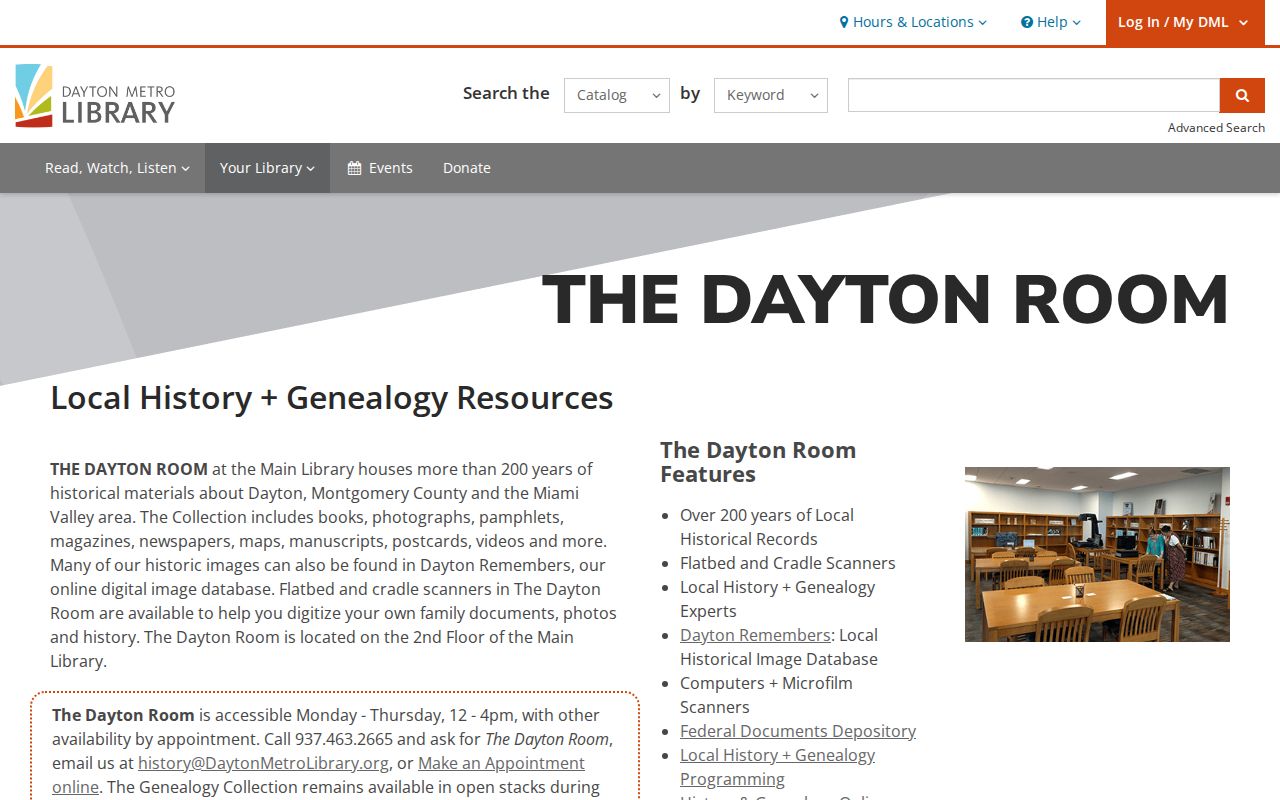
Its mix of staff help and collection access gives a reader a practical fallback when a directory title is not available as a searchable web record. Bring the spelling, the approximate year, and any known street or cross street.
Digitized Dayton City Directory Context
A directory entry is stronger when the printed address is tested against a period map. Dayton Remembers holds a digitized 1875 Montgomery County atlas with city and township business-directory context. Its 1870 Bailey Street Guide is derived from the city directory and has a street index. These materials can help locate a former street pattern or cross street before a name is carried into a deed, tax, or census search.
The digitized 1875 Montgomery County atlas is a useful visual companion to a Dayton city directory entry.
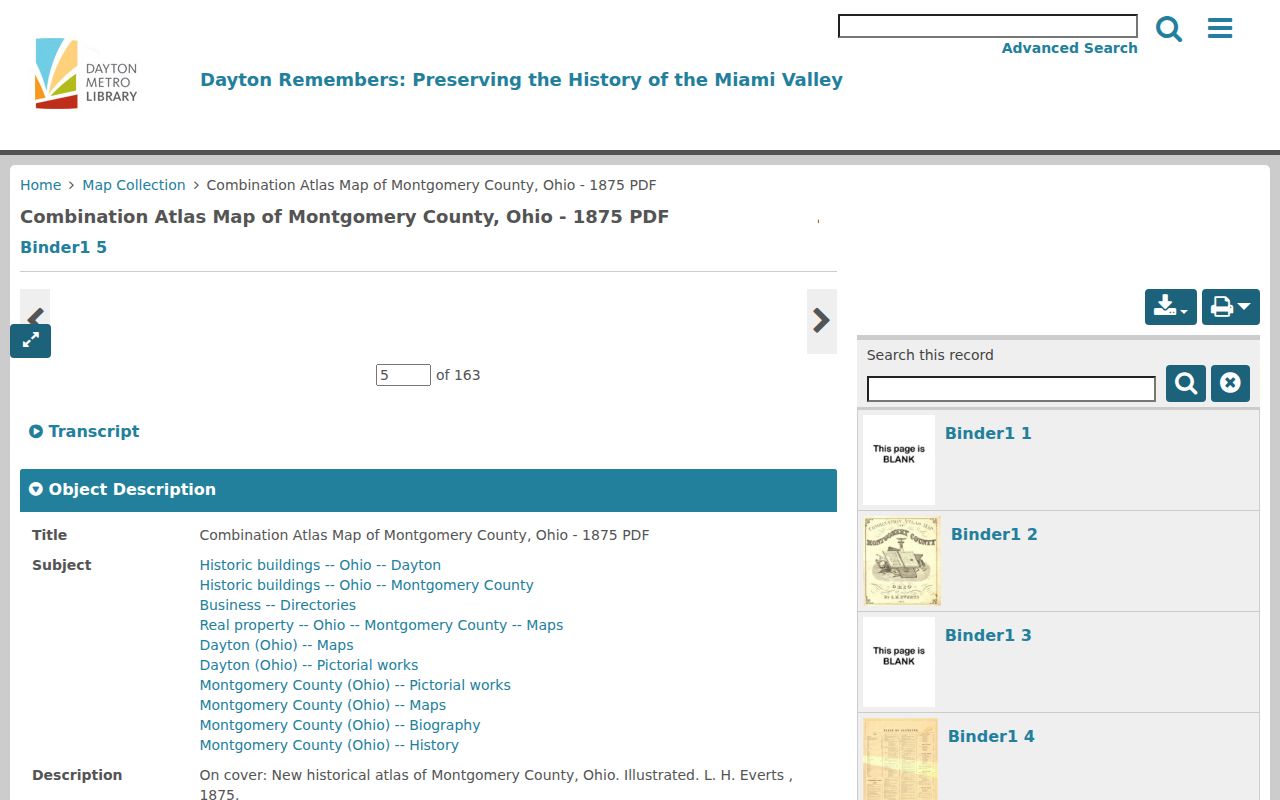
Maps show the setting of a listing, not the people in a household. Match the printed street side and cross street with the directory's date, then preserve any uncertainty in a research note.
How Dayton City Directory Entries Read
Entries are compact, so copy them exactly before expanding the search. A digitized 1856 example, “Bell John S. buckskin glove manuf. e s Jefferson b 6th and Canal,” shows the kind of information a line can carry: a name, a printed trade notation, a street-side reference, and a cross-street range. The 1914 Orville Wright example also shows why care is needed. It includes office and business locations plus an Oakwood address, so a Dayton listing can document an association without proving a home was in the city.
| Printed name | Keep initials, spelling, punctuation, and order exactly as the volume gives them. |
|---|---|
| Street reference | Record the number, street, side notation, and cross-street wording together. |
| Trade or business notation | Use it as a way to distinguish similar names, not as proof of a later address. |
| Family notation | Retain any spouse, widow, boarding, or relationship wording that is actually printed. |
| Volume context | Write down the year, publisher, page, and the abbreviation key used by that volume. |
- Criss-cross directory
- A directory arranged by street and number, used to move from a dated address to a listed name or telephone entry.
- Householder index
- A name arrangement that helps locate the principal listed person before checking the street sequence.
- Abbreviation key
- The volume's own explanation of shortened terms and symbols. Preserve it with the entry instead of assuming a mark means the same thing in every edition.
The Dayton Metro Library directory catalog search is the best first check for Haines and Polk titles.
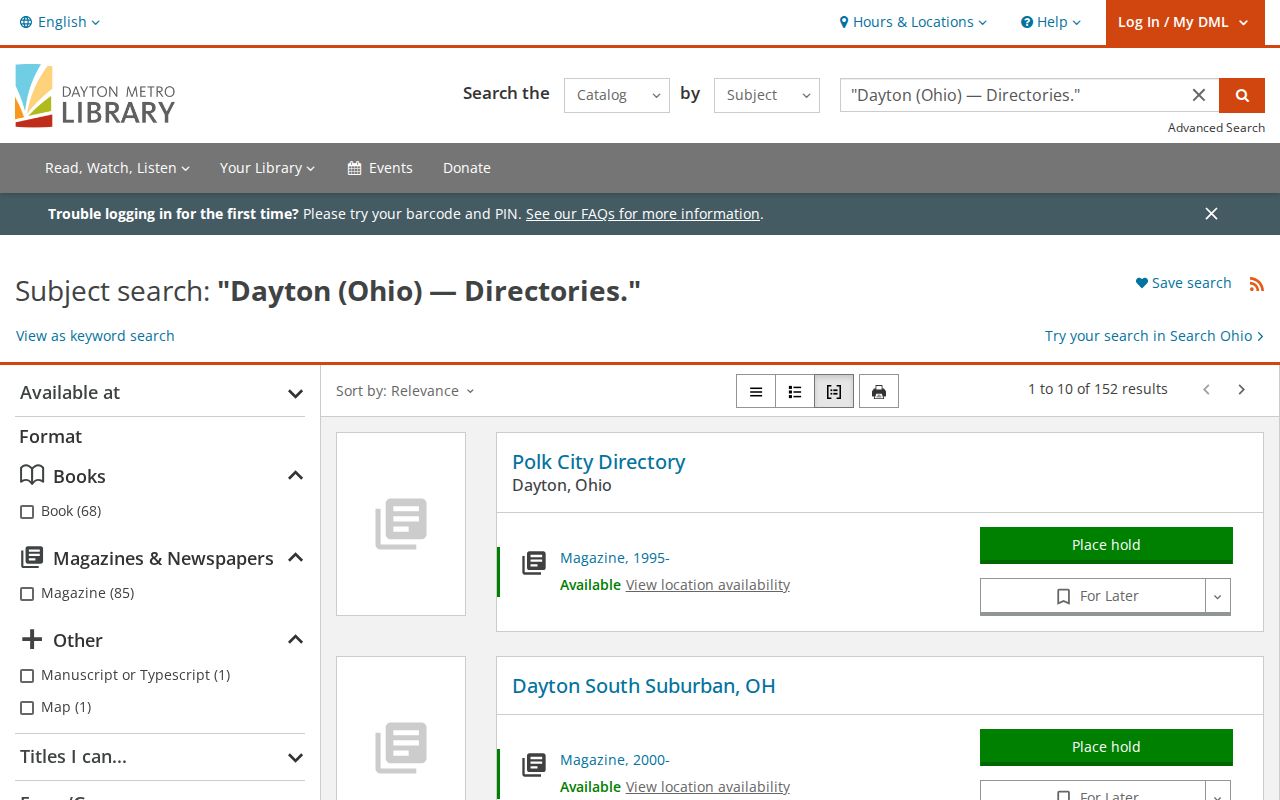
Catalog results establish that a title is held or described by the library. They do not replace opening the correct year and checking how that particular publisher organized an entry.
Dayton Directory Citations from HOBITS
A disappearance from a directory needs a second source. The Dayton Obituary and Genealogy Database, known as HOBITS, is a citation index rather than full obituary text. Its form allows Keyword, first and last name, publication, date, volume, issue, page, column, and sort searches. Its death-notice coverage appears in several dated blocks, including 1850-80, 1897-98, 1900, 1903-18, 1920-39, 1951-57, 1965, and 1985 to the present.
Search the Dayton Obituary and Genealogy Database, then give the complete result citation to the library when requesting a copy.
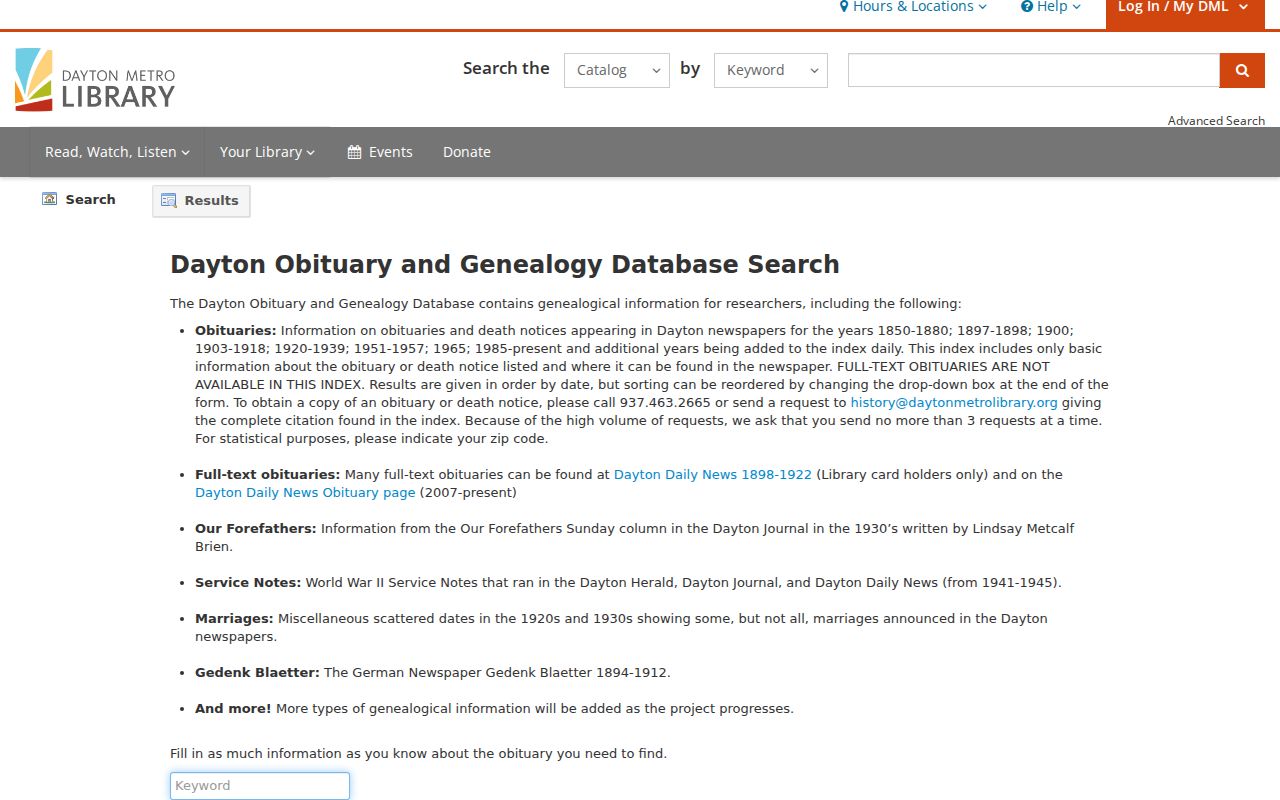
HOBITS asks for no more than three copy requests at once. That limit is a reason to collect the full citation first and use each request for a record that resolves a real question in the directory trail.
For a historical death-certificate lead, the Ohio History Connection death index covers its main Ohio set for 1913-44 and 1954-70. An index entry is a lead to a record, not the certificate itself.
Use the date gaps in that index carefully. A missing result cannot by itself rule out a death, a move, or a different spelling.
Trace Dayton Households Through Directories
Build the household trail one dated observation at a time. Start with the exact printed entry, then check the preceding and following volumes for the same initials, street, or trade notation. If the volume has a street or criss-cross section, test the address there as well. Pair the directory year with nearby parcel, deed, or tax material, then use the closest released federal census. The census release rhythm is 72 years, so it fills historical gaps rather than supplying a current household list.
- Copy the first confirmed directory entry, including the year, page, and abbreviation key.
- Check the prior and next available volumes for the same spelling, address, or street-side reference.
- Use the criss-cross arrangement when available to test the number against the name listing.
- Compare the dated address with nearby deed, tax, and parcel material, keeping the legal description separate from a street label.
- Pair the period with the closest released census, then use a HOBITS citation, probate record, or newspaper item to investigate a disappearance.
A missing name can reflect a move beyond the city, an altered spelling, a changed business listing, an omission, or a death. It is a question to test, not a conclusion. When the work shifts to a modern parcel or named street, the Dayton street directory has the current address-keyed record path.
Dayton Records Shelf Before the Web
Dayton's older directory trail sits beside an unusually deep county archive. Montgomery County was created in 1803, and its Records Center & Archives provides staff-retrieved, noncirculating research-room access to material reaching back to that era. The archive has more than 47,000 indexed storage locations and keeps dated deed, tax, probate, naturalization, marriage, and specialty series. Tax duplicates begin in 1803 and deed records in 1805, which can extend a family-history investigation well before a city directory name appears.
The 1913 flood did not erase the whole county record trail. Surviving books later required conservation, and the archive remains the right fallback when a digitized search stops. Ask for a specific name, record type, and date range rather than expecting an open shelf or a complete online index.
Note: A printed directory and a county-created record answer different questions, so retain the source, date, and exact wording for both.
Dayton Archive Collections Beyond Directories
Several local collections add context after a directory establishes a name and date. Wright State Special Collections & Archives holds Miami Valley material, a naturalization index for 11 counties including Montgomery, and Dayton Daily News files that are especially strong for 1930-80. University of Dayton Archives holds yearbooks, oral histories, photographs, and 1913 flood material. Dayton History maintains regional collections, including the NCR Archive. Each collection has its own access method and each is best used to answer a narrow historical question.
Access to some Wright State material improved in 2025 and 2026 through conservation, renovated preservation space, and digitization of selected Dayton Daily News photographs and Ivonette Wright Miller videos. Those projects widen the available local context, but they do not turn a special-collection item into a substitute for a dated directory or a county record.
Dayton City Directory Date Check
City directories are historical evidence. A line can identify a person or address as printed in a particular volume, but it does not certify a current address or a complete household. Keep business locations separate from residence wording, compare names against dates and relationships, and use the holding library or record custodian for the original material. That careful approach preserves the value of the Dayton city directory without asking it to answer a question outside its date and purpose.
For a hard-to-read line, preserve the page image or a full transcription with the volume year. A later record may confirm, correct, or complicate the listing, but it should not overwrite what the historical volume actually printed.