
Finding Dayton Residents in Order
Start with the strongest fact already in hand. For a current address, the Montgomery County Auditor's property search and the Treasurer's tax search can return the parcel, site address, owner names, and transfer clues. For a person, use an owner result only as a lead, then check a separate official source. Ohio's voter tool confirms a named registration record, while court and Recorder indexes can place a person in a dated public record. Each source has a narrower purpose than a general people list.
An address can identify a parcel without identifying everyone there. A tax mailing address can be for correspondence, not a physical location. A recorded deed names parties to an instrument, not necessarily present occupants. Treat the Dayton residents directory as a trail of records that must agree on an address, date, parcel, relationship, or document number. When the trail is historic, the Dayton Room and the County Records Center are often the next practical stop.
- Search the MCRealEstate property system by owner, address, or parcel and save the parcel identifier.
- Check the named record in Ohio's voter search with first name, last name, and Montgomery County.
- Use the Recorder's RISS portal for the recorded-document trail, then inspect the original image or physical index when needed.
- For an older household, consult Dayton Metro Library's directory catalog, newspapers, and obituary index rather than assuming a current portal reaches backward.
- Send a focused request to the custodian when a specific existing record is not online, identifying the record type, date range, address, or case number.
Where Dayton Resident Records Are Kept
Dayton's current records trail is county-centered. The Auditor identifies parcels and owners. The Recorder keeps recorded deeds, mortgages, plats, and related instruments. The Board of Elections handles voter records. A name inquiry can move among these offices, but each keeps a different kind of evidence. For a full address-by-address sequence, the Dayton street directory explains the parcel and deed chain in more detail.
Montgomery County Recorder
451 W. Third St., fifth floor
Dayton, OH 45422-1387
937-225-4275
Montgomery County Board of Elections
451 W. Third St.
Dayton, OH
937-225-5656
Records Center & Archives
117 S. Main St., sixth floor
Dayton, OH 45422
937-225-6366
The Recorder, Auditor, GIS, and elections office are clustered around West Third Street, while the archive is the handoff for staff-retrieved historical series. The Dayton Room at the Main Library is a separate but essential path for directories, maps, newspapers, and obituary citations.
Dayton Parcel Records Start the Search
The Auditor's MCRealEstate Owner Name Search is the best first stop when a Dayton address or owner name is known. Its owner field uses LastName FirstName, accepts wildcard characters, and offers tax-year, sorting, and results-per-page controls. Address and parcel modes supply the same bridge from a street location to the county's parcel identifier. Save the site address, parcel ID, owner name, mailing address when shown, tax year, values, and transfer reference before moving to another system.
The Auditor's owner-search screen shows the Dayton residents directory property entry point.
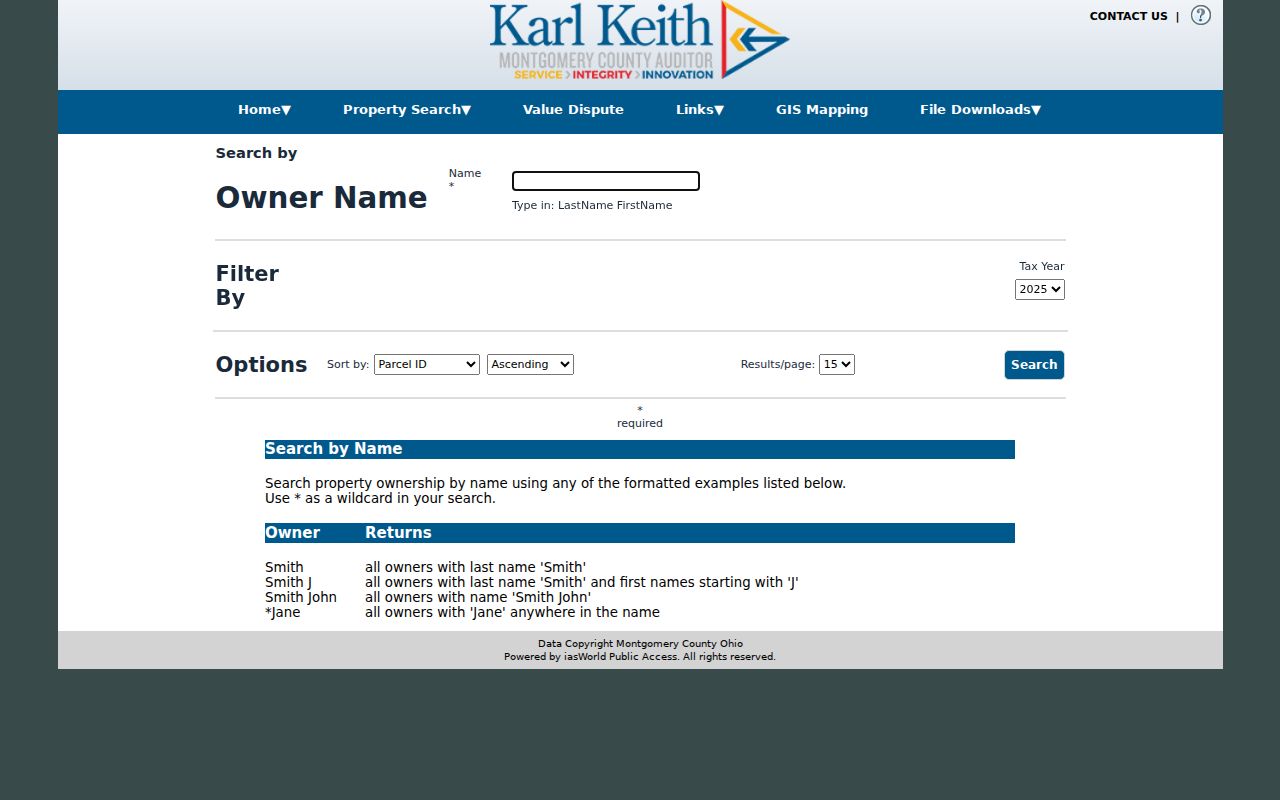
The screen's name-based controls are useful for a property lead, but a matching owner name alone does not establish current residence.
| Field or result | Why it matters |
|---|---|
| Owner name | Starts a property record search and can be tested with spelling variants. |
| Site address and parcel ID | Connect the property record to tax, GIS, and recorded-document systems. |
| Mailing address | Shows correspondence information when present, not proof of physical presence. |
| Transfer reference | Points toward the Recorder document that should be checked next. |
Note: A parcel card can establish a property connection, but not every person who may be associated with that address.
Dayton Resident Voter Confirmation
Ohio's My Voter Information search takes first name, last name, and county. Select Montgomery County for a Dayton search. It is designed to return the named voter's registration, precinct, and polling-place information. It is not a street-by-street browser, and it does not reveal ballot choices or a full household. Try a prior surname, a common derivative first name, or a former county address when the official instructions fit the situation.
The official voter lookup illustrates the required fields for a Dayton residents directory confirmation.
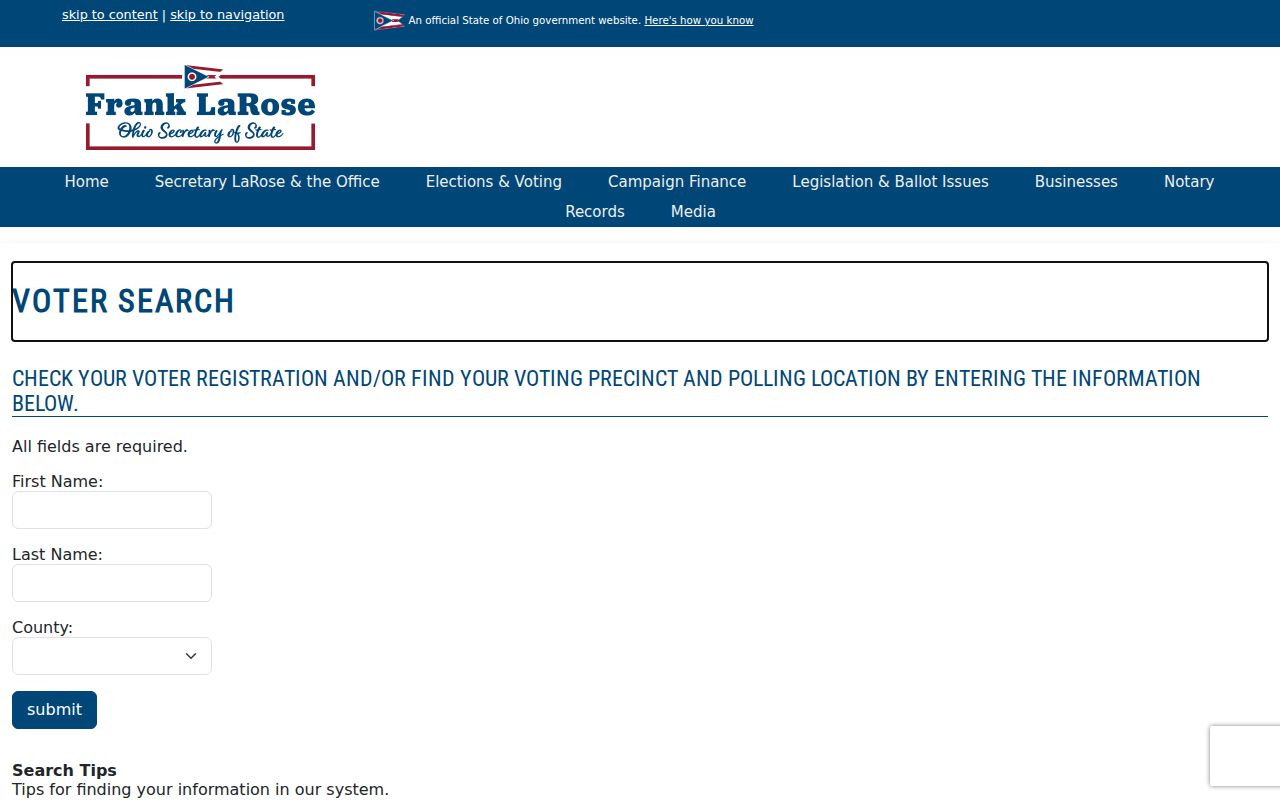
Ohio law makes registration information public subject to protected-address and confidential-data exceptions, so a missing result can reflect a safeguard rather than a failed search.
Dayton Court Names Need Context
A name can appear in different court systems for different reasons. Montgomery County Public Records Online, called PRO, covers traffic, criminal, and civil Montgomery County Municipal Court matters, Common Pleas criminal and civil matters, Domestic Relations, and Second District Court of Appeals records. Dayton Municipal Court maintains separate public pages for defendant, plaintiff, attorney, date, case-number, and docket routes. Probate Court keeps its own channel for estates, guardianships, marriage licenses, adoptions, and name changes.
The PRO court search landing page is the countywide path shown for this Dayton residents directory source.
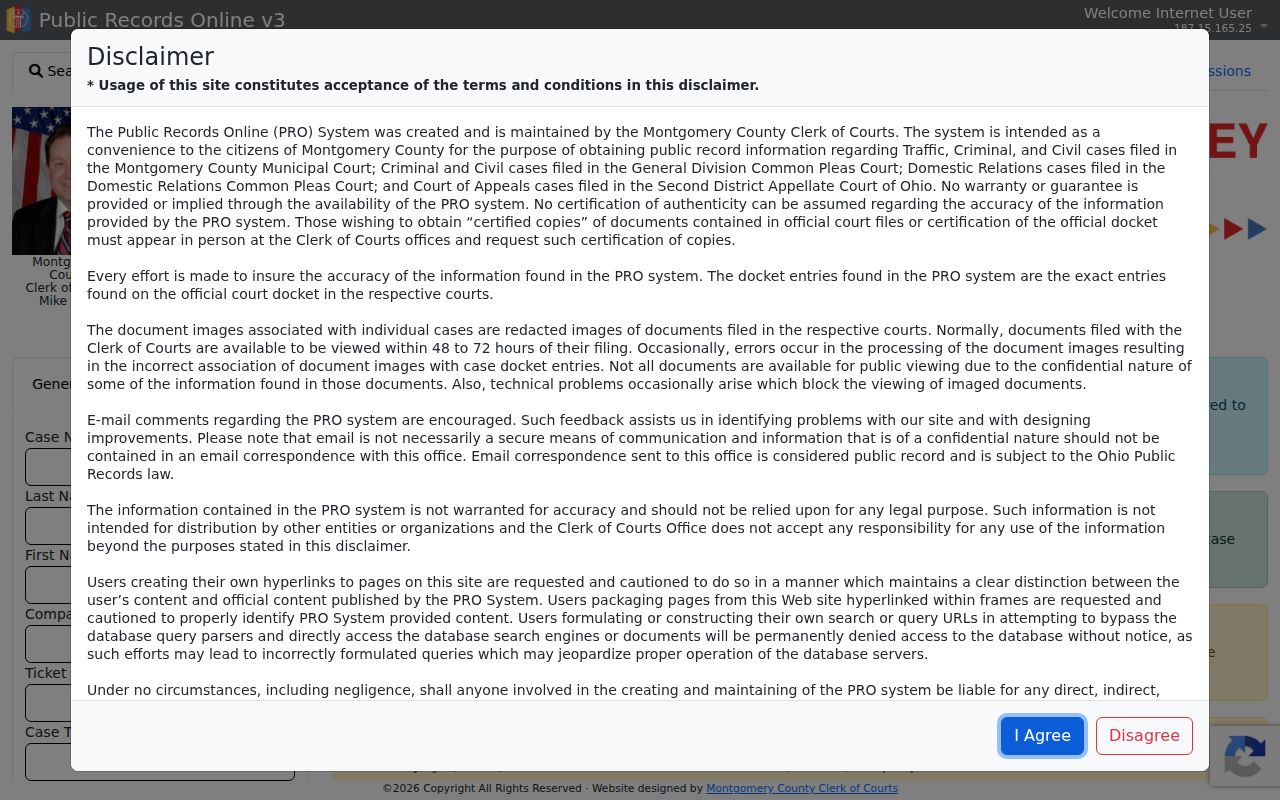
PRO is a convenience service, caps web results at 1,000, and does not make a web entry a certified record. Narrow a common name with the portal's current panels and match any hit to a case number or a separate identity factor.
The Dayton Municipal Court defendant search provides another dated name-and-case route.
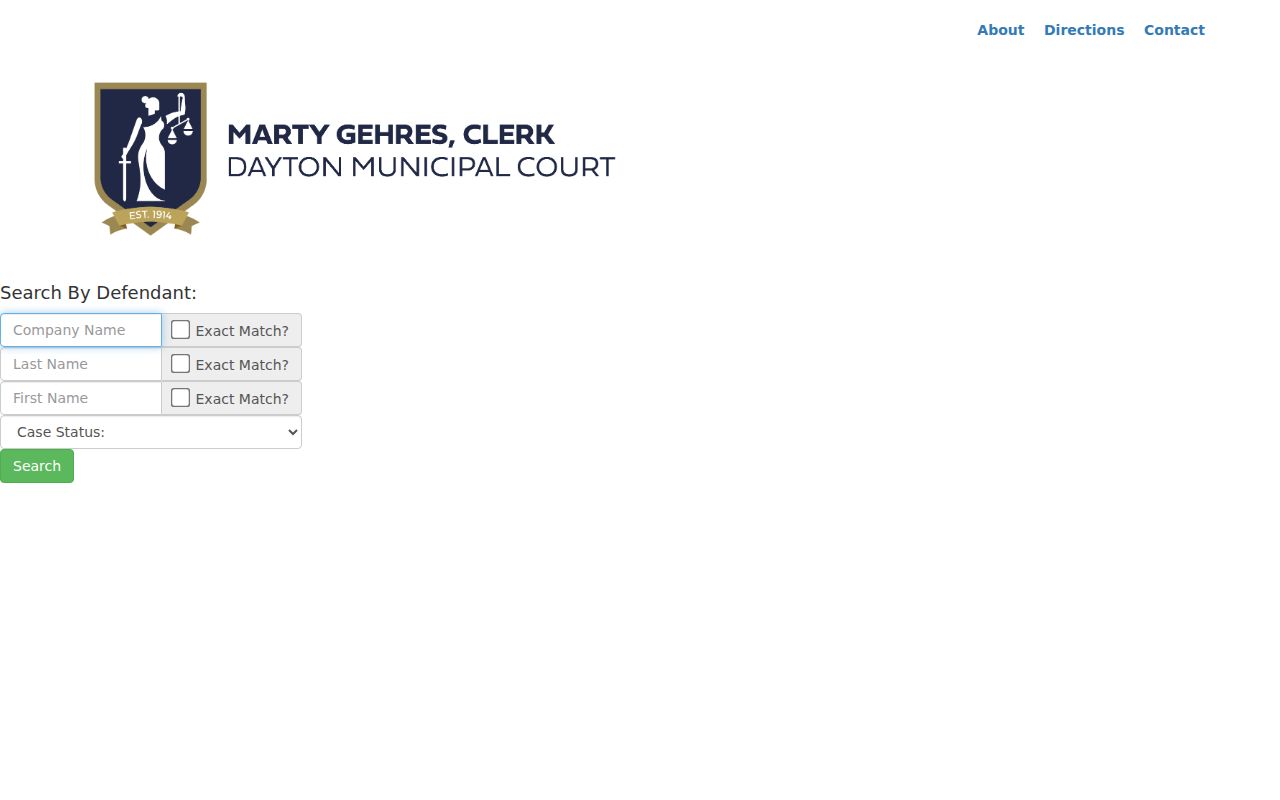
Its company, last-name, first-name, and exact-match controls work best for a known party or case, not as a broad directory of Dayton residents.
Dayton Deed Names Follow the Parcel
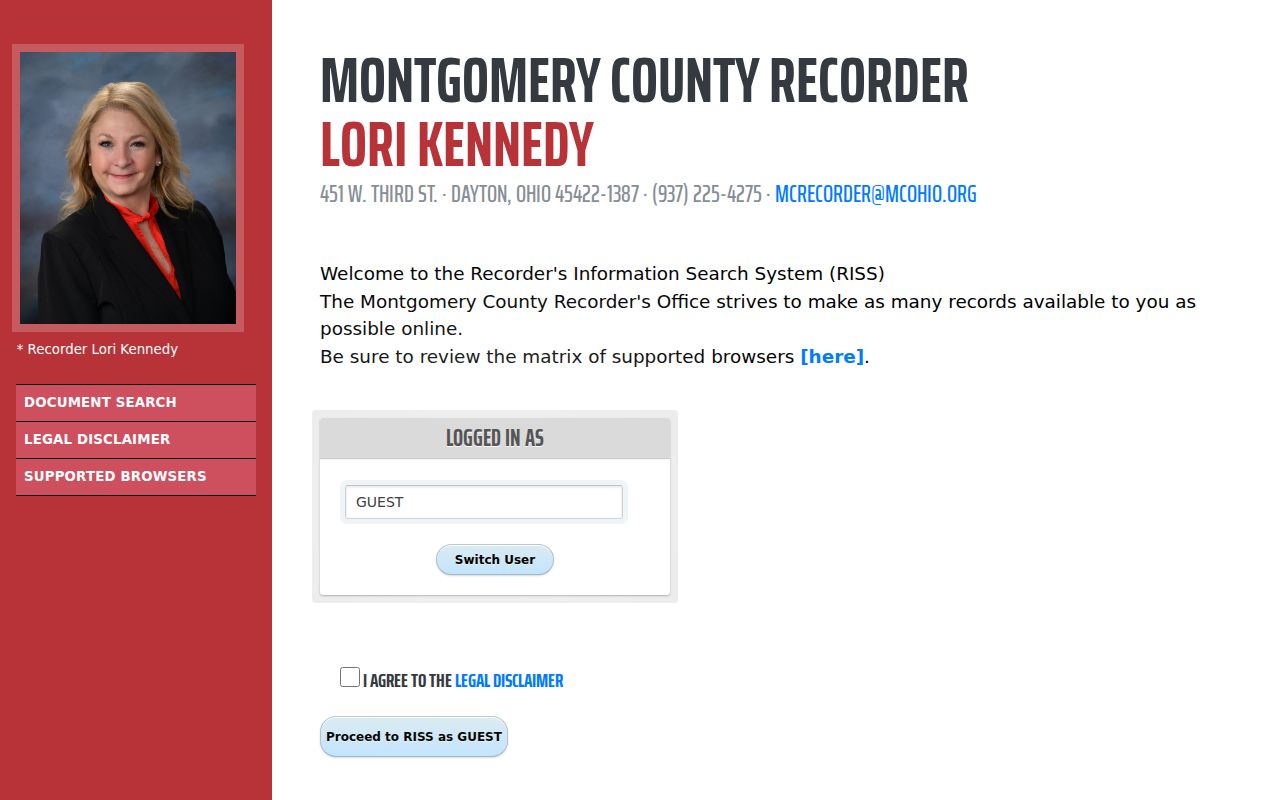
The Recorder's Information Search System, or RISS, is a recorded-document index, not a live occupancy list. Guest users accept its legal disclaimer before searching. By Name requires a last or firm name, offers an optional first name, and lets users choose Begins With, Contains, or Exactly. By Municipality can be narrowed to DAYTON. By Type can focus on deeds, mortgages, liens, plats, easements, leases, sheriff deeds, and other document categories. The record image or counter record is the item to inspect for the legal description and party roles.
The RISS access screen is the official recorded-document gateway for the Dayton residents directory.
Older title work does not end with a web result. The Recorder's alphabetical and tract indexes are available in books and microfilm from 1805 forward, and the Records Center holds deed records and indexes for documented historic spans.
Current Dayton Resident Directory Sources
No single current roll lists every Dayton resident. These official or civic sources answer narrower questions. Use the source whose keeper created the record, and keep the source's limits in the conclusion. The Dayton resident lookup process helps when a name must be verified across more than one record type.
| Dayton source | What it can show | Custodian | Access route |
|---|---|---|---|
| MCRealEstate / Treasurer | Parcel owner, site and mailing data, tax context | Auditor / Treasurer | Free online searches |
| Ohio voter search | Named voter's registration and precinct information | Secretary of State / Board | First name, last name, county |
| Recorder RISS | Recorded parties and instruments | County Recorder | Guest portal, counter, books, microfilm |
| City Resource Directory | Public civic-organization contacts | City of Dayton | Category, name, or A-Z search |
| County court systems | Public docket information by party or case | Clerk, courts, Probate | Portal and counter under court rules |
The Treasurer's selected-year tax search supplies a useful companion view.
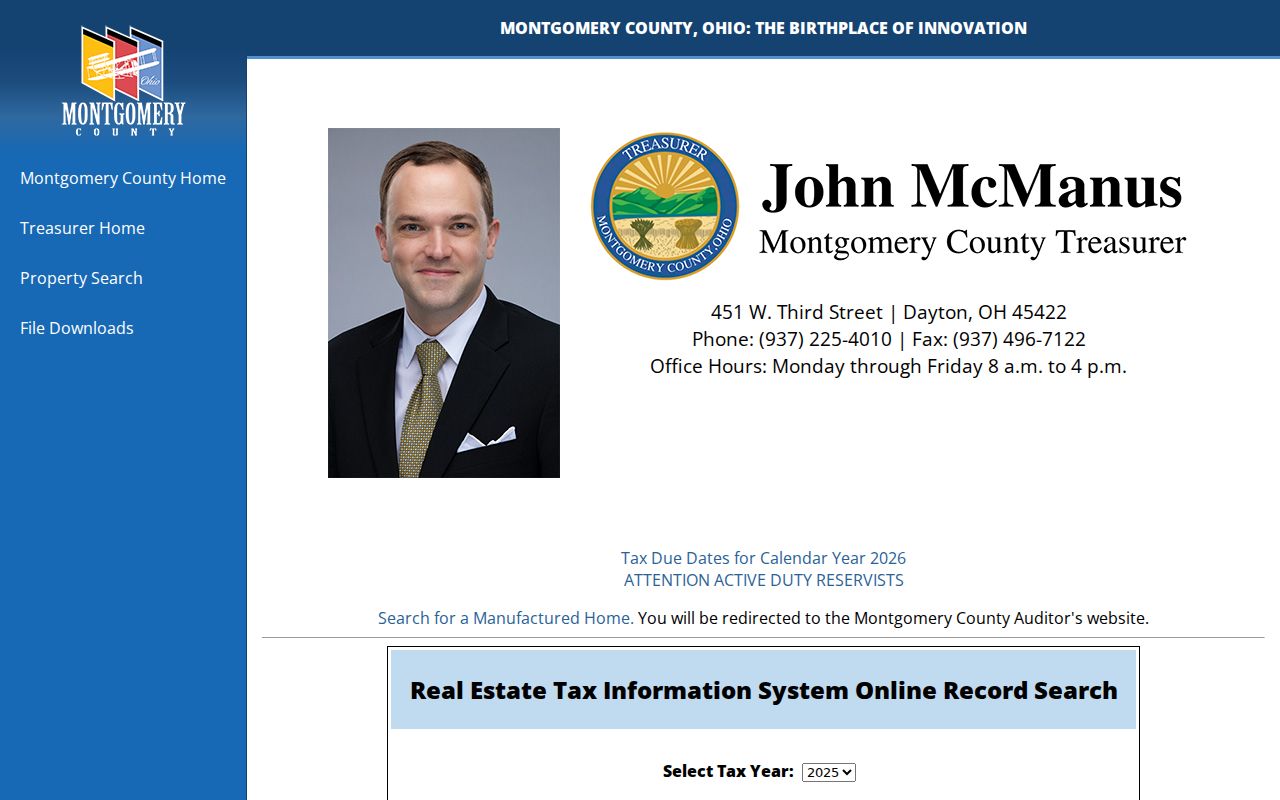
Choose one pathway at a time there: parcel ID, owner name, or property address. The tax bill can show up to two deeded owners and “et al.”, so it is not a substitute for the recorded deed.
Dayton Records When Portals Stop
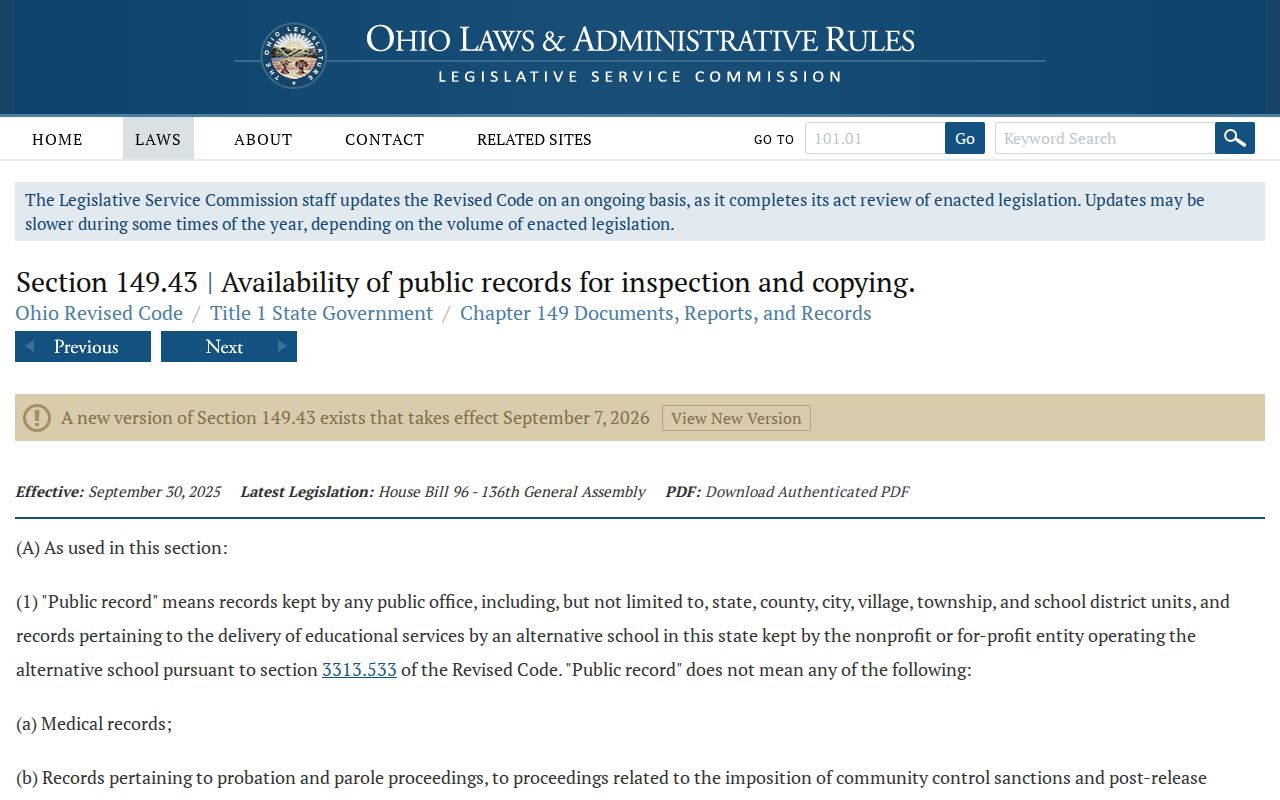
Ohio's Public Records Act, R.C. 149.43, requires public offices to allow prompt inspection and provide copies within a reasonable period, subject to the work needed for review and lawful redaction. A request normally does not require identity or intended use. The useful request is specific: name the custodian, record type, address or case number, date range, and desired format. The County says routine records should be supplied immediately when feasible, while larger research requests receive an acknowledgment with expected time, cost, and any likely exemption.
The Ohio Public Records Act text is the statewide rule behind this Dayton residents directory fallback.
For county records, Montgomery County's request page routes births, deaths, court matters, permits, tax liens, and other categories to the office that maintains them. It lists paper copies at ten cents per page, email as free, and added postage or supplies for mailed copies.
Dayton's Historical Resident Directories
For earlier Dayton residents, start at the Dayton Room in the Main Library, 215 E. Third Street. Its local-history collection has more than two centuries of Miami Valley material, including city directories, maps, newspapers, photographs, and genealogy tools. Staffed Dayton Room hours are Monday through Thursday, noon to 4 p.m., with appointments available. Open-stack genealogy material remains available during regular library hours. The catalog documents Polk and Haines city and criss-cross directory titles; these volumes can connect a listed name to an address or, for applicable years, an address to a listed name or phone.
City directories are dated snapshots. An entry can preserve initials, occupation, business or residence wording, and street context, but it cannot prove a current address. For the complete collection runs, publisher history, entry-reading method, and household sequence, use the Dayton city directory resource. Pair a directory year with a parcel, deed, tax, census, obituary, or probate source instead of treating a single listing as final.
- Parcel
- A county identifier for a piece of land that links property, GIS, tax, and deed research.
- Index
- A finding tool that points to a record; it is not always the record image or a certified copy.
- Criss-cross directory
- A directory arranged by street or address rather than only by a person's name.
- Roll
- A list maintained for one administrative purpose, such as registration or taxation, not a full resident census.
Dayton Death and Probate Leads
Vital records, obituary citations, and probate files answer different questions. Public Health - Dayton & Montgomery County handles local birth and death service, while the Ohio Department of Health is the state channel. Montgomery County Probate Court handles marriage licenses and local marriage records, and the Clerk's office is the route for divorce decrees. The County archive holds local birth and death material for 1867 through 1908, while Ohio state registration begins in 1908. The Ohio History Connection death index has documented coverage for 1913-1944 and 1954-1970, with a gap between those runs.
The Ohio Department of Rehabilitation and Correction search is a separate, time-sensitive custody tool sometimes encountered during a records inquiry.
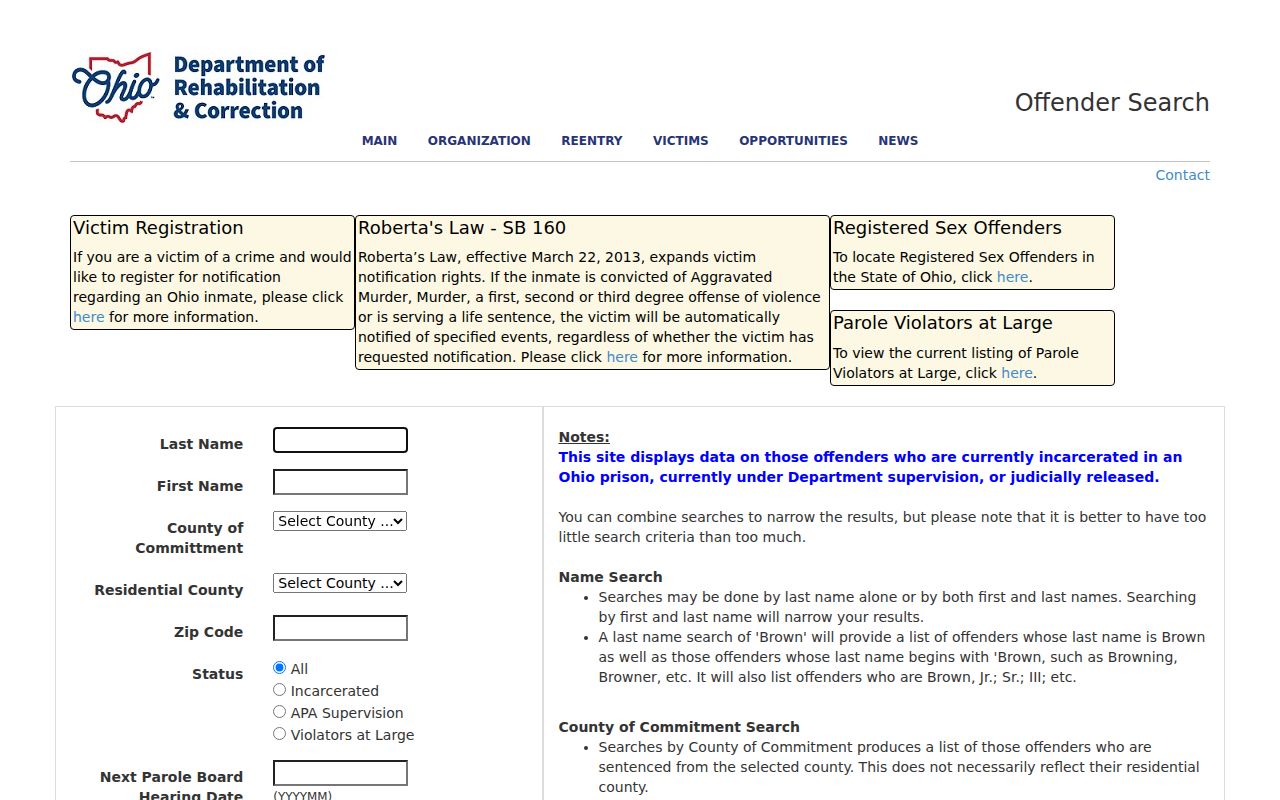
That state locator is not a complete criminal-history file and does not establish a Dayton address. For historic death notices, HOBITS is a citation index rather than full text; give the Dayton Room the full citation when requesting a copy, and keep requests to no more than three at once.
Dayton Deed Alerts Add a Check
Montgomery County Recorder's Fraud Alert Notification program, known as FAN, lets an owner receive notice when a document is recorded under a monitored name. It is a safety notice, not a title decision or an accusation. An unexpected alert should lead back to the Recorder and the recorded image for independent verification. The Recorder announced a fraud pre-check before the Auditor transfers a quitclaim deed in February 2025, making the normal parcel-to-Recorder sequence especially important for a Dayton property question.
March 2025 activity reported in the Recorder's April newsletter included 5,978 records, 1,568 deeds, and 1,371 e-recordings. Those totals show why a dated Recorder check is more useful than relying on an old directory listing or a copied claim.
Dayton Resident Records Have Limits
Official sources are more reliable than commercial people-finder listings because they identify the keeper, date, and scope of a record. They still do not supply a complete picture of a household. Records can be wrong, out of date, limited to a transaction, or protected by law. A public tax mail-to address is not proof of where someone lives. A court docket can be sealed or redacted. A voter search does not disclose ballot selections. The responsible approach is to record the source date and return to the custodian when a result matters.
| Official source | Useful evidence | Key limit |
|---|---|---|
| Auditor or Treasurer | Parcel and tax context | Owner and mailing data may differ from occupancy. |
| Recorder | Recorded party and legal description | Instrument participation is not current residence. |
| Voter search | Named registration confirmation | Protected fields and addresses are excluded. |
| Dayton Room or archive | Historic person and address leads | A historical entry is tied to its own date. |
Lawful use. Use Dayton records for personal, lawful research and never to stalk, harass, intimidate, or harm another person. Ohio's Safe at Home program and court protections can lawfully restrict access.